Key facts: Liquid Barrier Treatment
- The US EPA lists liquid soil-applied termiticides among approved termite treatments [1].
- The EPA notes that conventional barrier treatments require trained pest management professionals [1].
- Fipronil is one active ingredient used in termiticides [2].
- People applying pesticides in and around structures in Texas are licensed through the Department of Agriculture [3].
In this page
- 1When a liquid barrier is often recommended
- 2How a liquid termite barrier works
- 3Trenching and rodding along the foundation
- 4Liquid figure
- 5Drilling through patios, driveways and slabs
- 6Repellent and non-repellent products
- 7Liquid treatment and Formosan termites
- 8Safety, labels and licensing
- 9What a liquid treatment day looks like
- 10Where liquid treatment goes on a Houston house
- 11What to expect afterward
- 12Keeping the barrier intact
- 13Liquid barrier or bait stations?
- 14Treating a pier-and-beam house
- 15Treating a slab house in detail
- 16Why thorough coverage matters
- 17Weather, soil and timing in Houston
- 18Spot treatments and partial barriers
- 19When retreatment is needed
- 20Questions to ask before a liquid treatment
- 21Townhomes, duplexes and shared walls
- 22How long treated soil stays effective
- 23Wells, ponds, gardens and pets
- 24Patches, plugs and appearance
- 25Additions, porches and attached structures
- 26Why Formosan activity may need more
- 27Comparing liquid treatment plans
- 28Living at home during a liquid treatment
- 29Drainage and the treated zone
- 30Situations a soil barrier will not solve
- 31Records to keep after a liquid treatment
- 32Planning renovations after treatment
- 33Signs a liquid treatment is working
- 34Choosing a professional for a liquid treatment
- 35When neighbors treat too
- 36Putting mulch back after treatment
- 37More questions about liquid treatment
- 38Questions about liquid termite treatment
When liquid fits
When a liquid barrier is often recommended
Liquid treatments suit many Houston houses, especially where the perimeter is accessible.
Active subterranean termites
Mud tubes or swarmers from the soil.
Read moreSlab homes with cracks
Treating under and around the slab.
Read morePier-and-beam homes
Treating soil around piers and the perimeter.
Read moreNew owners wanting protection
A treated perimeter after an inspection.
Read more
How it works
How a liquid termite barrier works
Subterranean termites live in the soil and travel through it to reach wood. A liquid treatment places termiticide in the soil where they are likely to pass: along the foundation, around piers, under slabs at cracks and penetrations, and along places where pavement meets the house. Older products were repellent, meaning termites avoided treated soil. Many modern products are non-repellent: termites cannot detect them, pass through the treated zone, pick up the active ingredient and share it with nestmates before they die.
The goal is a continuous treated zone with no gaps. Any untreated gap, such as under a patio that was not drilled, can let termites through.
Trenching and rodding
Trenching and rodding along the foundation
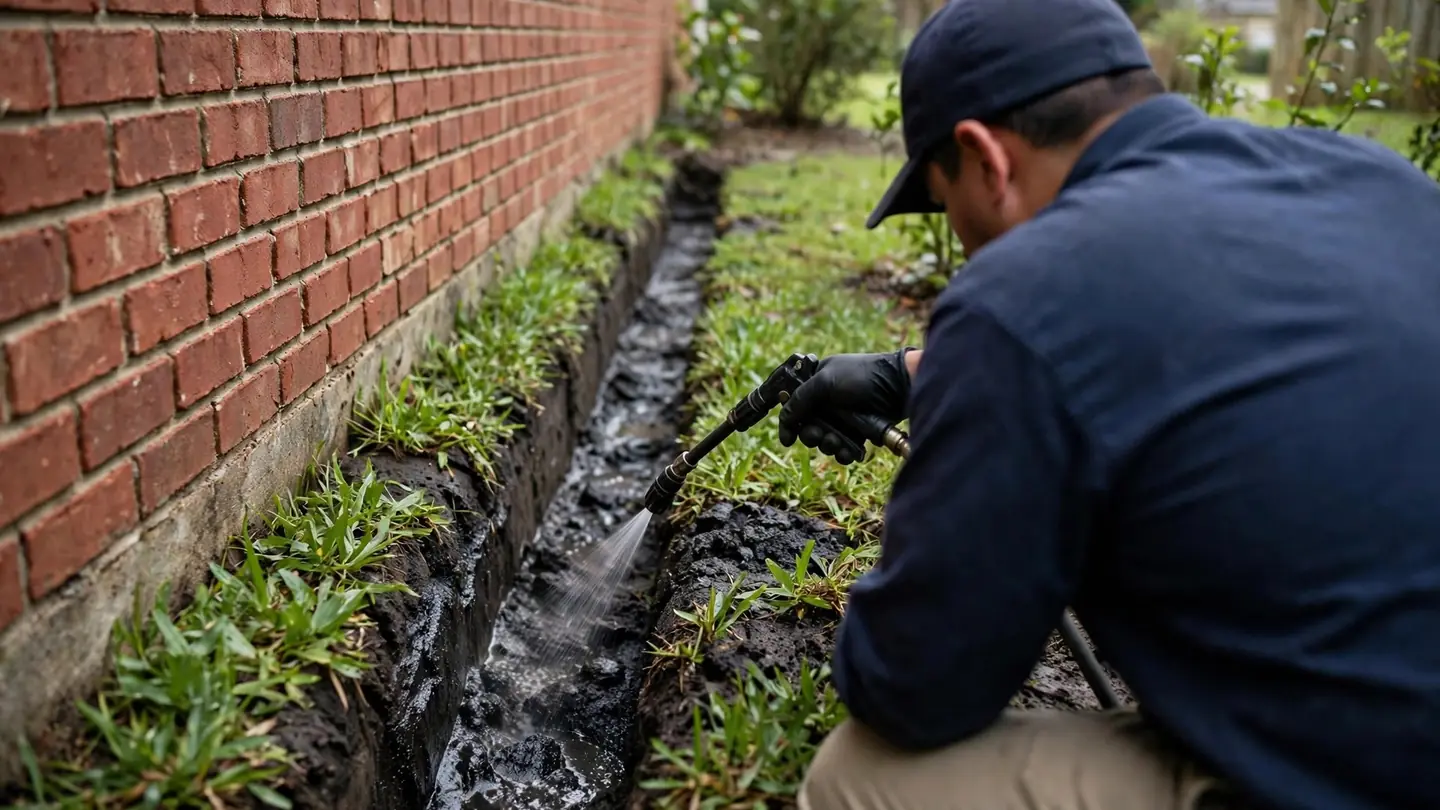
Along an exposed foundation, the technician digs a narrow, shallow trench next to the slab or perimeter wall. Termiticide is applied into the trench and often injected deeper with a rod pushed into the soil at intervals, so the treated zone reaches down toward the footing. The soil is mixed with termiticide as it is returned to the trench. Around piers in a crawlspace, the same approach treats soil next to each pier.
Mulch, rock and plantings next to the house are pulled back during the work and may be replaced afterward, though keeping a strip near the foundation clear helps over the long run.
Liquid figure
Drilling slabs and pavement
Drilling through patios, driveways and slabs
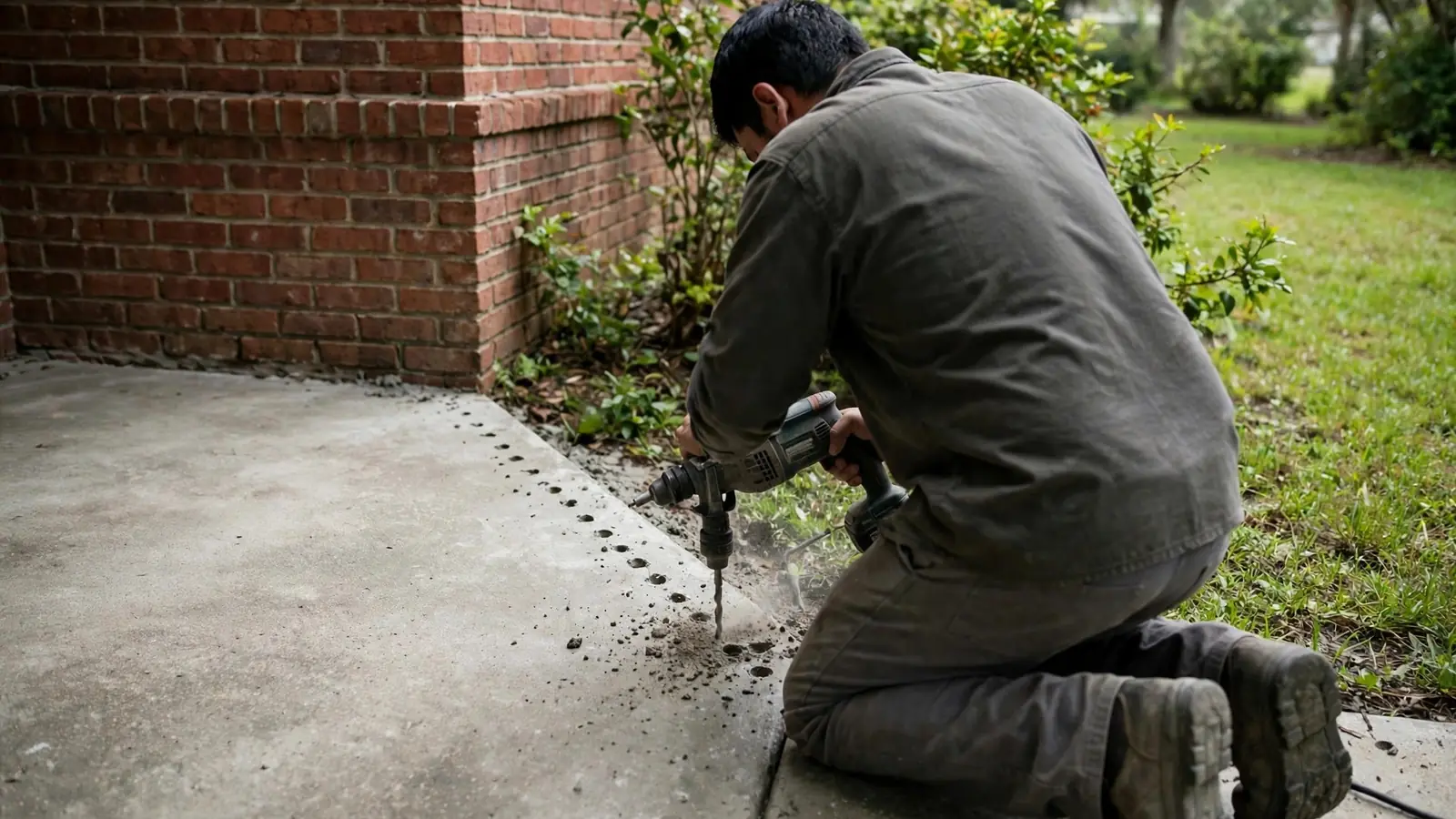
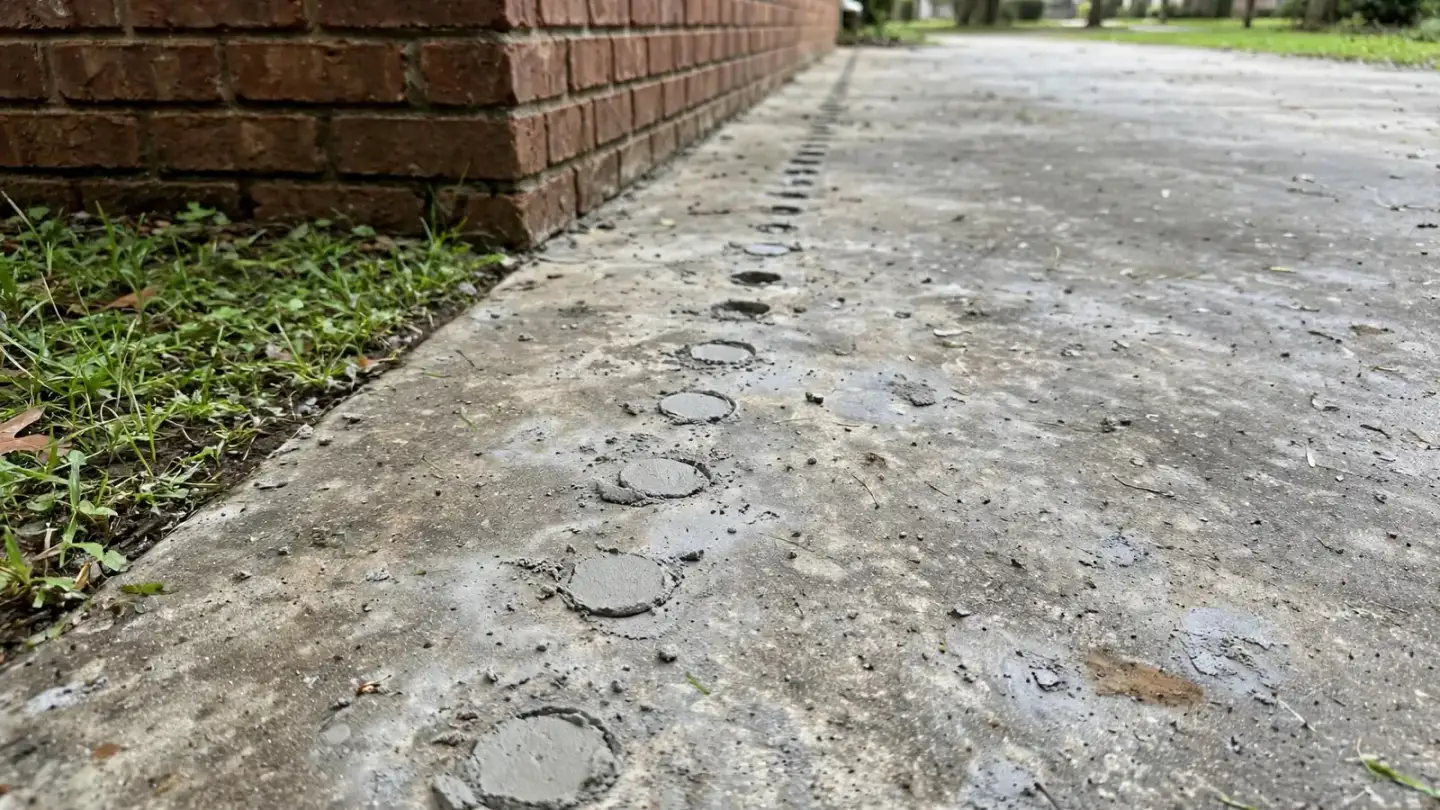
Where concrete meets the house, such as a patio, driveway, sidewalk or garage apron, the soil underneath cannot be reached by trenching. The technician drills small holes through the concrete near the foundation at regular spacing and injects termiticide into the soil beneath. Inside, they may drill at bath traps, plumbing penetrations and slab cracks. Holes are patched afterward. Patches are usually visible up close, though they fade over time.
Drilling through finished floors inside is done only where needed, and the professional explains where before starting.
Repellent and non-repellent
Repellent and non-repellent products
Repellent products create a zone termites avoid. They can work well when the barrier is continuous, but termites that find a gap simply go around. Non-repellent products, such as those containing fipronil, are undetectable to termites, so they move through treated soil and carry the product back to the colony. [2] Many professionals prefer non-repellents for active infestations. The professional chooses a product registered for termite use and applies it according to its label.
Formosan colonies
Liquid treatment and Formosan termites
Formosan colonies are large and can nest above ground in walls where moisture is available. A soil barrier stops new termites entering from the soil and kills foragers that pass through it, but an above-ground nest fed by a roof or plumbing leak may need separate attention. Fixing the moisture source and treating the nest area are often part of the plan. Some professionals combine liquid treatment with baits for Formosan activity.
Safety and the label
Safety, labels and licensing
Termiticides are pesticides, and their labels set how they must be applied. In Texas, people applying them in and around structures are licensed through the Department of Agriculture. [3] The EPA notes that improper soil treatment can contaminate drinking water and fail to protect against termites, which is why professional application matters. Ask what product will be used and for a copy of the label or safety information if you want it.
If you have a well, a pond, a vegetable garden next to the foundation or a pond with fish, mention it on the call.
Treatment day
What a liquid treatment day looks like
- 1
Walkthrough
The technician confirms the plan and areas to treat.
- 2
Prepare
Mulch and plants near the foundation are pulled back.
- 3
Trench and rod
Soil along the foundation is treated.
- 4
Drill
Concrete next to the house is drilled and treated.
- 5
Interior
Plumbing penetrations and cracks are treated where planned.
- 6
Patch and clean up
Holes are patched and the area restored.
Areas treated
Where liquid treatment goes on a Houston house
| Area | Method |
|---|---|
| Exposed soil along slab | Trench and rod |
| Patio, driveway, sidewalk | Drill and inject |
| Bath traps and plumbing | Interior drilling where needed |
| Slab cracks and joints | Drill and inject |
| Piers in a crawlspace | Trench around each pier |
After treatment
What to expect afterward
Swarmers may still appear in the weeks after treatment, because termites already inside the structure need time to contact the treated zone. Mud tubes may be rebuilt briefly and then abandoned. Keep the treated zone undisturbed: avoid digging along the foundation, adding soil above the slab edge or replanting beds against the house without asking. Report any new activity to the professional.
Maintaining the barrier
Keeping the barrier intact
Landscaping projects, new patios, plumbing repairs and foundation work can break a treated zone. If you plan any of these, ask the professional whether the area should be retreated afterward. Keeping gutters working and leaks fixed helps the barrier and makes the house less attractive to termites.
Choosing liquid or baits
Liquid barrier or bait stations?
Liquid treatment works quickly and treats the soil directly, but requires trenching and drilling. Bait stations disturb less of the property and target the colony, but take longer and need regular monitoring. Many Houston houses can use either, and some use both. The liquid versus bait stations guide compares them.
Pier-and-beam treatment
Treating a pier-and-beam house
On a raised house with a crawlspace, the treated zone has to surround the perimeter and every pier. The technician trenches along the inside and outside of the perimeter foundation or skirting where there is soil, then around each pier in the crawlspace, applying termiticide into the trench and rodding deeper where needed. Chimney bases, porch footings and steps that rest on soil are treated too. Crawlspaces with low clearance, ductwork or plumbing in the way take more time and care. Wood debris on the crawlspace floor is usually removed, since it feeds termites and can bridge the treated soil.
Slab treatment details
Treating a slab house in detail
On a slab home, the exterior perimeter is trenched where soil meets the slab. Wherever concrete, such as a patio, driveway, porch or sidewalk, abuts the house, the technician drills through it at intervals close to the foundation and injects termiticide beneath. Inside, they may drill near plumbing penetrations, along cracks and at expansion joints, and treat open bath traps directly. The goal is to leave no untreated route from the soil into the structure.
Some houses have stone or tile floors, finished flooring over slab cracks, or radiant heating in the slab. Mention these, because they affect where drilling is possible and may change the plan.
Volume and coverage
Why thorough coverage matters
Product labels specify how much diluted termiticide to apply per length of foundation and depth of footing. Under-applying leaves gaps; skipping a patio or a section behind a deck leaves a route. A thorough treatment takes time, especially on large houses with lots of concrete around them. Ask how the technician will treat areas that are hard to reach, such as under air conditioning pads, behind decks and along fences attached to the house.
Weather and timing
Weather, soil and timing in Houston
Houston's heavy rains can saturate the soil. Treating soaked soil can be less effective and risk runoff, so technicians may reschedule after a downpour. Very dry soil can be harder to trench but holds product well. Treatment can be done in any season, though swarm season in spring is when many owners call. Ask how weather might affect your appointment.
Spot treatments
Spot treatments and partial barriers
Sometimes a professional treats only part of a house, such as one side where activity was found or a bathroom with an open bath trap. Spot treatments are quicker but leave other sides untreated. Termites may simply move to an untreated area. Ask whether a spot treatment is meant as a complete solution or a temporary measure, and what warranty terms apply.
Retreatment
When retreatment is needed
Treated soil can be disturbed by new landscaping, plumbing repairs, foundation work, additions or flooding. Product in the soil also breaks down over time at different rates depending on conditions. If termites return, the professional may retreat the affected area or the whole perimeter. Treatment warranties often describe retreatment terms, so read them carefully.
Questions to ask
Questions to ask before a liquid treatment
Which product will you use, and is it repellent or non-repellent? Where will you trench and where will you drill? Will you treat inside, and where? How will you patch holes? How long until termite activity should stop? What happens if termites come back? Is there a warranty, and does it cover retreatment, repairs or both? Can it transfer if I sell? Getting these answers in writing helps you compare plans.
Talk to a local contractor
Questions about liquid barrier treatment?
One call connects you with an independent termite treatment contractor who serves Houston.
Product breakdown
How long treated soil stays effective
How long a soil treatment lasts depends on the product, how much was applied, the soil type, moisture, temperature and whether the soil is disturbed. Labels and studies give general guidance, but real conditions vary. Houston's heat and rain can shorten effective life in exposed soil. That is why many professionals pair treatment with periodic inspections, and why warranties describe what happens if termites return.
Wells, ponds and gardens
Wells, ponds, gardens and pets
Termiticide labels include precautions near water sources. If you have a well, cistern, pond, creek or drainage ditch near the house, the technician may need to adjust methods or choose another approach, such as baits, for that area. Vegetable gardens along the foundation and fish ponds also need attention. Keep pets off treated soil until it dries, and ask about any other precautions for your household.
Patching and appearance
Patches, plugs and appearance
Drilled holes in concrete are filled with patching compound or plugs. Patches are usually a slightly different color from the surrounding concrete and visible up close, though they weather over time. On decorative concrete, stamped patios or pavers, ask whether holes can be placed in joints or less visible spots, or whether pavers can be lifted and replaced instead of drilled.
Treating additions and porches
Additions, porches and attached structures
Additions, enclosed porches, chimneys, attached garages and decks each have foundations or footings that need treatment. Where an addition on a slab meets an original pier-and-beam house, both foundation types need coverage. Porches and steps resting on soil are treated around their footings. Ask the technician to walk you through each attached structure and how it will be treated.
Liquid and Formosan colonies
Why Formosan activity may need more
Formosan colonies can be so large that termites keep testing treated soil from many directions. Non-repellent products help, but where a colony has established a nest above ground, inside walls or an attic, the soil treatment may not reach it. Finding and fixing the moisture source, treating the nest area and adding baits are common additions. Ask how the plan addresses any above-ground activity.
Comparing plans
Comparing liquid treatment plans
If you talk with more than one professional, compare plans carefully rather than looking only at the summary. Does each plan treat the full perimeter, or only part? Will each drill every patio, driveway and walkway against the house? Does each treat inside at bath traps and plumbing penetrations? Which product will each use, and is it repellent or non-repellent? What follow-up inspections are included, and what happens if termites return? Two plans that sound similar on the phone can differ a great deal in what they actually cover. Ask each professional to put the plan in writing with a simple diagram of treated areas.
Living through treatment day
Living at home during a liquid treatment
Most families stay home during a liquid treatment. Expect noise from drilling and some dust inside if interior drilling is planned. Keep children and pets indoors or away from the work areas until treated soil has dried. Close windows near drilling to limit dust. Move cars from the driveway if it will be drilled. If you work from home, plan around drilling times. The crew should clean up dust and debris and patch holes before leaving. Ask how long the work will take so you can plan the day.
Drainage after treatment
Drainage and the treated zone
Good drainage protects the treated zone. Soil that stays soaked or that washes away from the foundation during heavy rain can reduce how long a treatment holds up. Gutters, downspout extensions and soil graded to slope away from the house help. Avoid adding new soil or mulch against the foundation afterward, which can cover the slab edge and create a bridge over treated soil. If you plan regrading or drainage work, talk to the professional first.
When liquid is not enough
Situations a soil barrier will not solve
A soil barrier does not reach drywood termites, which live entirely inside wood, or Formosan nests that have moved above ground and no longer need soil contact. It cannot stop termites already inside the structure from feeding until they contact treated soil. It also cannot compensate for wood touching soil, like a fence nailed to the house or siding buried in mulch. The professional should identify these situations during inspection and include extra steps in the plan when needed.
Records to keep
Records to keep after a liquid treatment
Keep the written plan, the product name, the date of treatment, a diagram of treated areas and any warranty or service agreement. If you sell the house, buyers and their inspectors will ask for these. If termites return, the records show what was treated and when, which helps the professional decide on retreatment. Store photos of the drilled and patched areas as well.
Treatment and renovations
Planning renovations after treatment
If you plan an addition, new patio, pool, foundation repair or plumbing work under the slab, talk to the professional before the work starts. New concrete poured against the house can cover treated soil without treating beneath it, and trenches for plumbing can cut through the treated zone. The professional can treat new areas as they are built or retreat disturbed sections afterward, keeping protection continuous.
Signs the treatment is working
Signs a liquid treatment is working
In the weeks after treatment, termite activity should fade. Mud tubes that you break should not be rebuilt. Swarmers may still appear in the next season from termites already inside, but fewer over time. If you see rebuilt tubes or fresh damage months later, call the professional to check the treated zone and look for gaps.
Choosing who treats
Choosing a professional for a liquid treatment
Look for a professional who inspects before quoting a plan, identifies the termite type, explains which areas will be treated and how, and puts it all in writing. Ask for the Texas license numbers of the business and the applicator. Be cautious of anyone who proposes treatment without inspecting or who cannot explain where the product will go. A clear plan, a named product and written terms are signs of careful work.
Neighboring treatments
When neighbors treat too
Termite colonies forage beneath property lines. If a neighbor treats their house, termites from a shared colony may shift their foraging. A treated zone around your own house protects it regardless, but it helps to know when neighbors have activity. In dense blocks of older homes, owners sometimes compare notes after swarm season.
Mulch after treatment
Putting mulch back after treatment
After treatment, keep mulch a few inches below the slab edge and away from siding, and use a thin layer. A visible slab edge lets you spot new tubes quickly.
More liquid questions
More questions about liquid treatment
Can liquid treatment be done in the rain?
Heavy rain or saturated soil may delay treatment to avoid runoff and poor coverage.
Will the product smell?
Some products have a mild odor during application. Ask about your specific product.
Does liquid treatment need monitoring visits?
The treatment itself does not, but periodic inspections are wise.
Can I see the product label?
Yes. Ask the professional for the label or safety data sheet.
Liquid treatment questions
Questions about liquid termite treatment
Do I need to leave the house during a liquid treatment?
Usually not, though you may be asked to keep pets and children away from the work areas until the soil dries.
Will drilling damage my patio?
Small holes are drilled and patched. Patches are usually visible up close.
How long until termites stop showing up?
Activity often slows over weeks as termites contact the treated soil.
Can I replant beds after treatment?
Ask first. Digging along the foundation can disturb the treated zone.
Does liquid treatment work on drywood termites?
No. Drywood termites live in the wood and need a different approach.
Is liquid treatment safe for my garden?
Products are applied by label directions. Mention edible gardens near the house on the call.
What should I tell the professional?
Foundation type, patios and driveways against the house, any well or pond, and where you saw signs.